
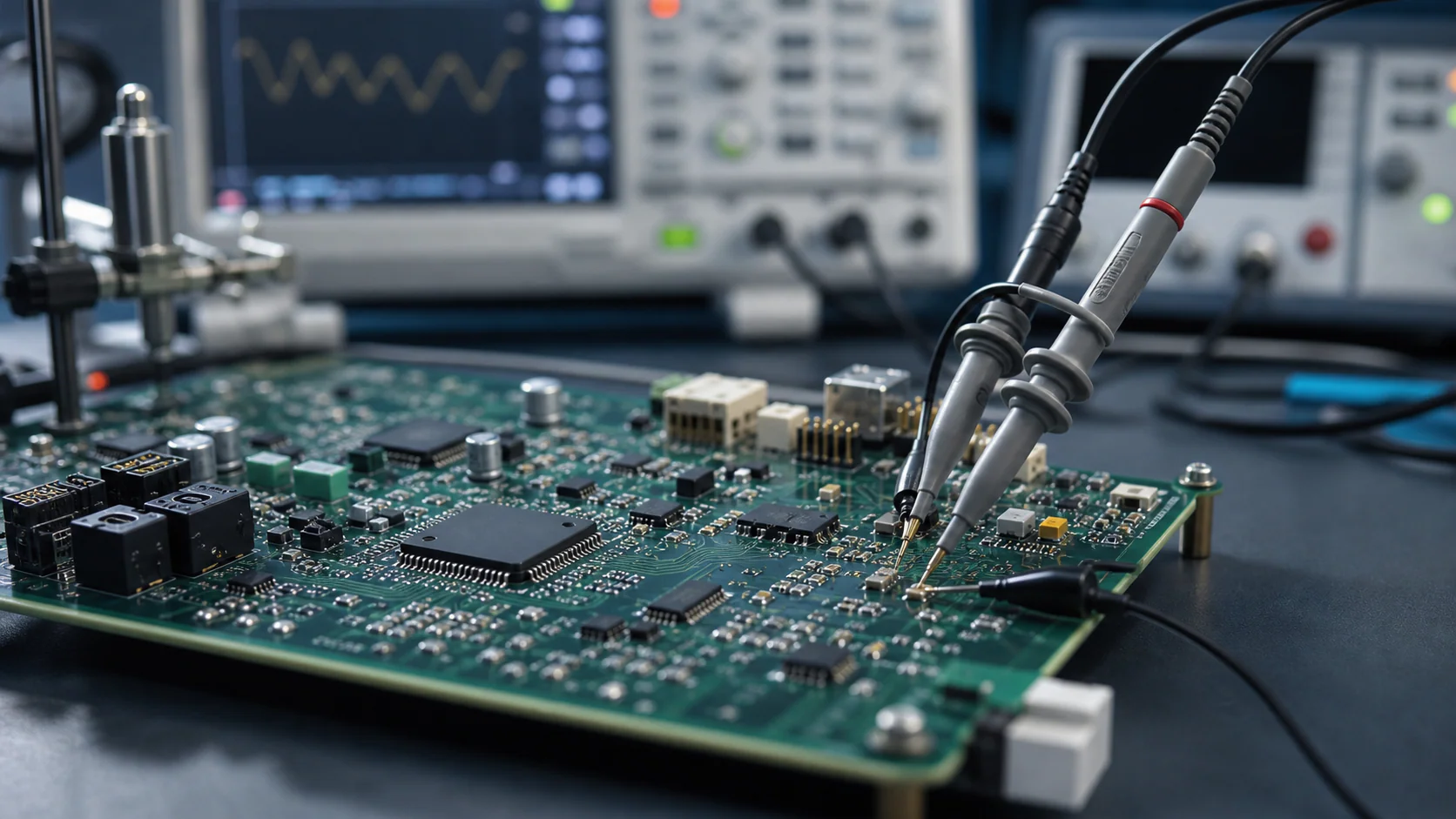
Electronic products rarely fail because of one stress alone
Electronic product reliability emerges from the interaction of component, PCB, interconnect, housing, software and real environment. Temperature cycling, humidity, vibration, electrical load and manufacturing variation can jointly excite mechanisms that an isolated standard test will not reveal.
RelTest plans electronics environmental testing, analyses intermittent field failures and applies DoE, HALT-oriented development testing, lifetime models and physical failure analysis. The core task is translating the use profile into a testable stress and mechanism map.
A passed test is valuable only if it addresses the right risk.
RelTest connects the use environment, physical failure mechanisms and test parameters. This reveals what may be accelerated and where a test would unintentionally create another mechanism.
- EnvironmentDescribe temperature, humidity, vibration and electrical load.
- MechanismAssess ageing, corrosion, interconnects and component variation.
- TestPlan stress profiles and acceleration on a physical basis.
- AssessmentAccount for failures, censoring and uncertainty statistically.
Distinguish electronic systems by stress path
A power module ages differently from a sensor or connected control unit. The test strategy must make those differences visible.
Power electronic inverter
High junction temperatures and power cycles stress chip, bonds, substrate and cooling path.
Risk fieldPower-cycling damage, bond-wire lift-off, solder fatigue, delamination and increasing thermal resistance.
EvidenceMission profile, temperature swing, load cycling and degradation features are connected in one model.
Industrial sensor
Humidity, media, sealing, contacts and calibration determine measurement function in the field.
Risk fieldDrift, corrosion, contact interruption, membrane or seal ageing.
EvidenceCombined climate and functional test, drift limit and analysis by location and production lot.
Embedded control unit
Hardware, firmware, power supply and communication must work across all operating states.
Risk fieldReset, brownout, timing faults, solder cracks and sporadic communication failures.
EvidenceState-based system tests, electrical transients, temperature cycling and event logging with a clear failure definition.
PCB under environmental and functional test
Temperature, humidity, supply conditions and function act on electronic products at the same time. Synchronized stress and event logging make short interruptions reproducible and traceable to a specific assembly or interface.
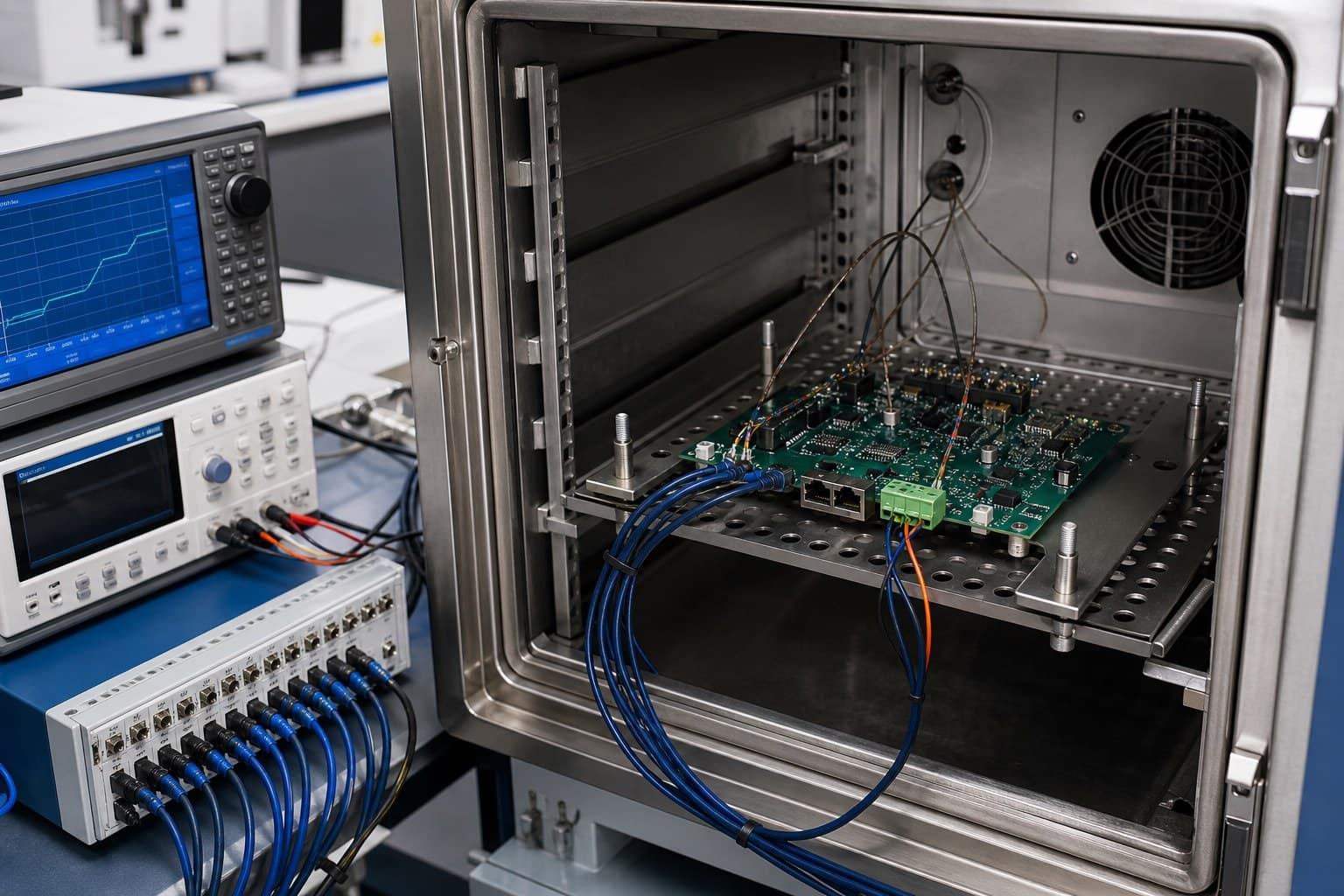
Project example: Make intermittent sensor failures under humidity and temperature reproducible
- Challenge
- A sensor briefly loses its signal in the field. Returned units work at room temperature and standard climate tests remain inconclusive.
- Approach
- RelTest defines the failure function precisely, combines humidity, temperature cycling, supply and connector state in a focused DoE, and specifies triggers and logging for short interruptions.
- Result
- A reproducible stress path separates contact, sealing and electronics hypotheses. Design changes can then be assessed with the same metric.
Deliverables: failure and event definition · stress-mechanism matrix · DoE test plan · change-effectiveness evidence
From intermittent symptom to physical cause
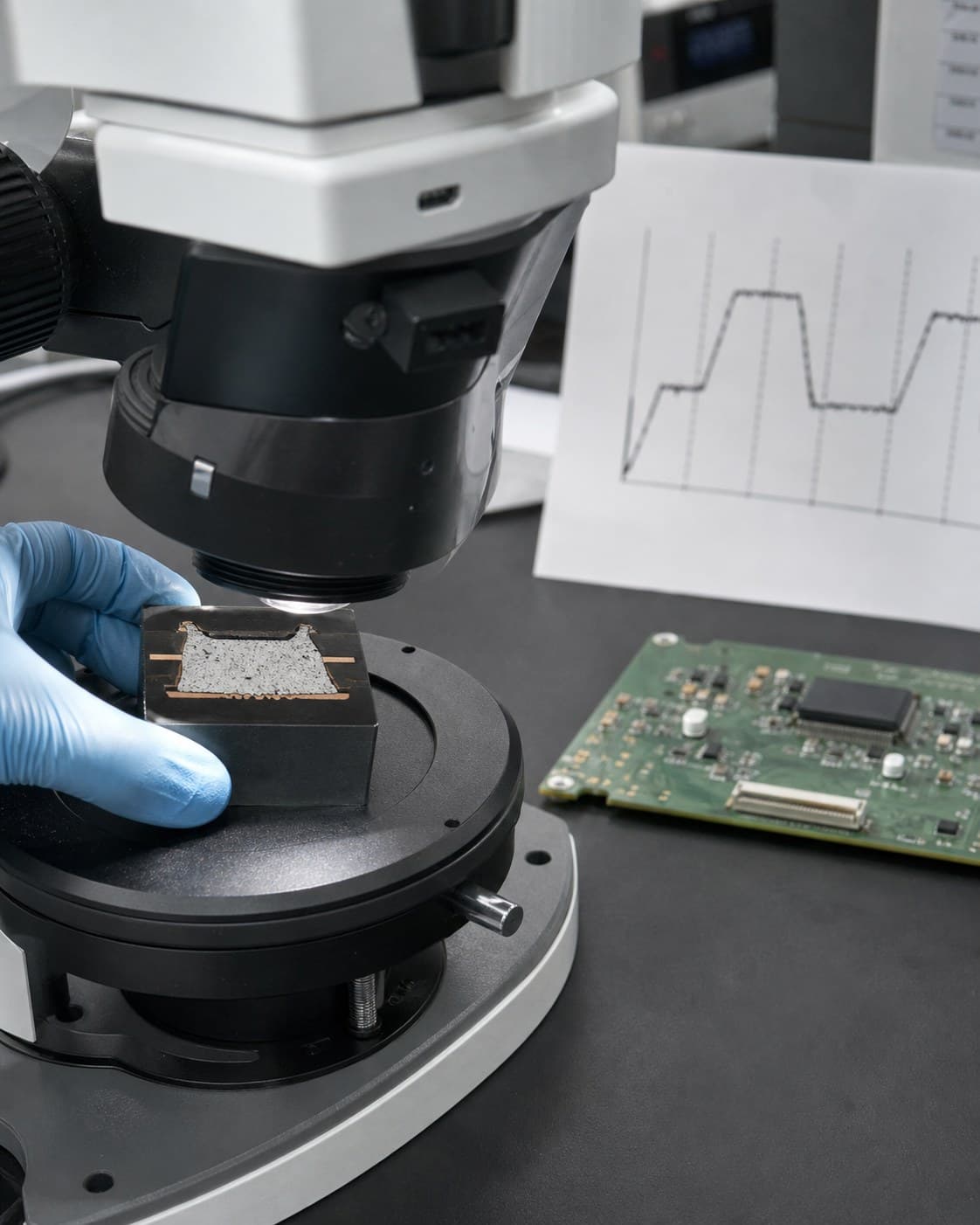
A cross-section alone does not explain a field failure. Linking the solder-joint finding, temperature-cycle profile and electrical event reveals the active mechanism and whether a design change is effective.
Assuring electronics methodically and economically
We work on components, assemblies and devices. The key is the combination of product understanding, relevant testing and sound data assessment.
Reliability targets and ageing models
We structure requirements, identify relevant stresses and assess how ageing and use influence expected lifetime.
Focus areas: Lifetime targets · Ageing models · Use profiles
Explore serviceFailure mechanisms and risk analysis
Technical risks are assessed at component and system level. We derive effective prevention and evidence measures.
Focus areas: Mechanism-oriented FMEA · Derating · Assurance plan
Explore serviceEnvironmental testing and DoE
Experimental design and statistical planning identify influencing factors, interactions and robust parameter regions efficiently.
Focus areas: Temperature and humidity · DoE · Life data analysis
Explore serviceTechnical knowledge
Environmental testing becomes stronger when it is connected to causal analysis and efficient experimental design.
Questions we clarify at project start
Are we testing real ageing or only a severe standard profile?
We compare stress, failure pattern and acceleration assumption and verify that the relevant mechanism is preserved.
Which factors drive failure variation?
A structured experiment separates main effects, interactions and random variation.
How do we assess tests without failure?
Failure-free tests can provide evidence when sample, duration, target and confidence are planned consistently.
How do we connect laboratory and return data?
Shared features and load information reveal whether laboratory and field represent the same population and mechanism.
Engineering context
Using test standards with engineering judgement. Standards and customer requirements provide an important framework. The technical statement emerges only when profile, product use and expected mechanism match.
IEC 60068 context · Environmental testing · Accelerated ageing · Component and process variation