
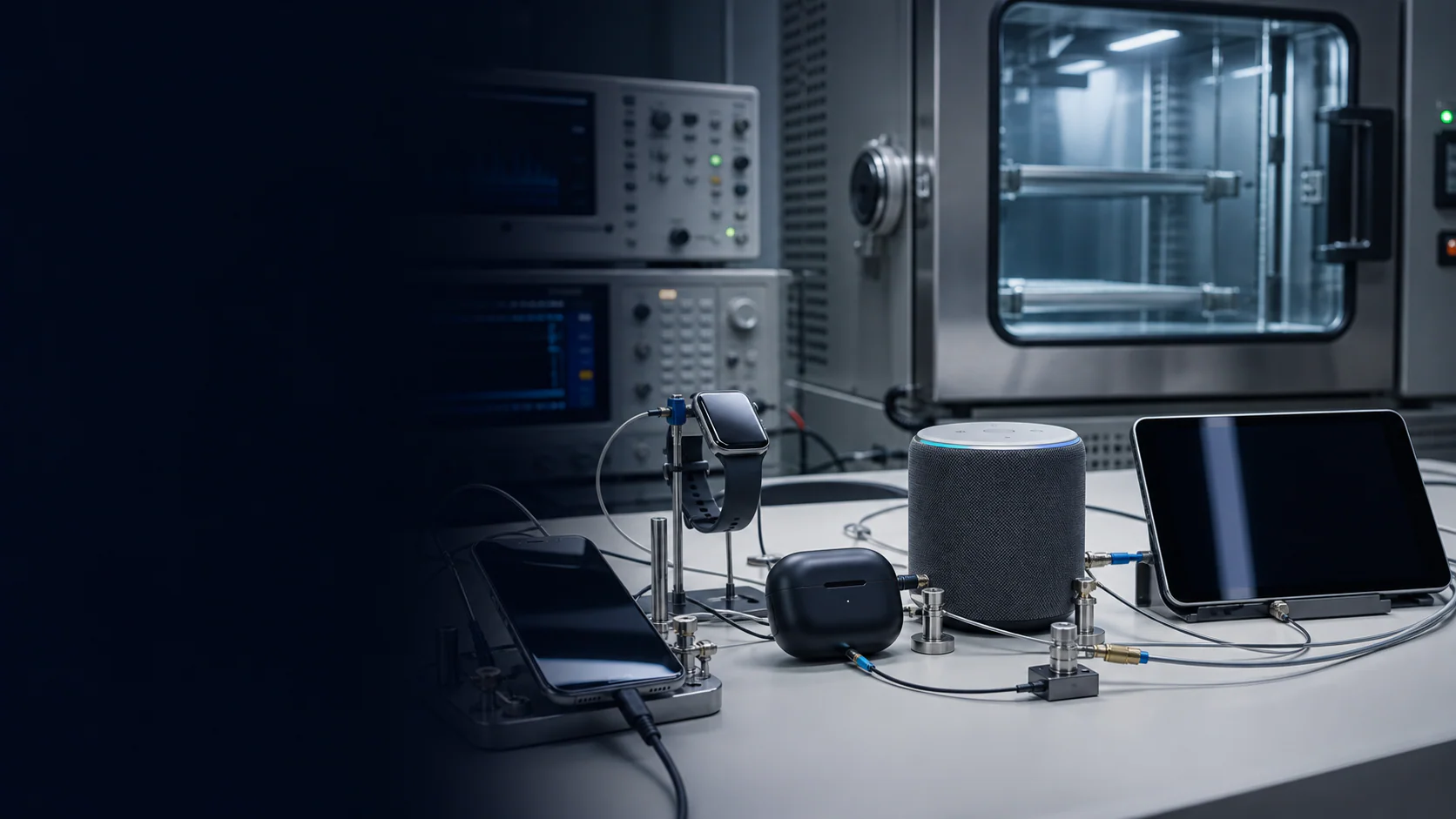
Consumer products must withstand real use, foreseeable misuse and high volumes
Consumer product reliability is not decided in the laboratory alone. Smartphones, wearables, cordless tools, smart-home products and appliances experience drops, humidity, charge cycles, blocked ventilation, changing users and high manufacturing variation. At scale, rare failures quickly become commercially and safety relevant.
RelTest combines consumer electronics testing, battery and charge-profile assessment, accelerated life testing, field data analysis and risk management. The focus is on robust products, transparent warranty assumptions and test strategies that distinguish normal use from foreseeable misuse.
Robustness must match real use, not an idealised user.
RelTest structures use profiles, misuse, environments and product variation. Tests can then be prioritised, returns understood faster and improvements focused on customer experience and cost.
- UserCapture duration, frequency, environment and misuse.
- ProductPrioritise critical functions and cost-driving failures.
- TestAssess robustness and lifetime with efficient experiments.
- LearningTransfer returns and reviews into the next generation.
Usage spectrum rather than one standard test
Customers treat products differently. That variation belongs in the engineering reliability assessment.
Smartphone or wearable
State of charge, temperature, drops, humidity and continuous body contact create a broad use spectrum.
Risk fieldBattery overheating, display and housing damage, seal loss, connector and contact problems.
EvidenceUsage segments, drop and climate testing, charge-cycle data and clear safety and functional limits.
Cordless power tool
High power pulses, dust, impacts, deep discharge and changing battery packs stress the full system.
Risk fieldCell ageing, contact resistance, motor temperature, gearbox wear and protective shutdown.
EvidenceLoad-profile system tests, temperature and current logging, and comparison of multiple user classes.
Connected household appliance
Mechanics, water handling, electronics, software updates and years of standby operation interact.
Risk fieldLeakage, pump wear, sensor drift, relay or power-supply failure and update-induced functional faults.
EvidenceLifetime cycles, fault-tree analysis, field data and regression-capable functional tests.
Usage scenarios for a battery product
High load, dust, charging behaviour and idle periods create very different stresses. Representative usage profiles prevent tests and warranty forecasts from describing only a theoretical average user.
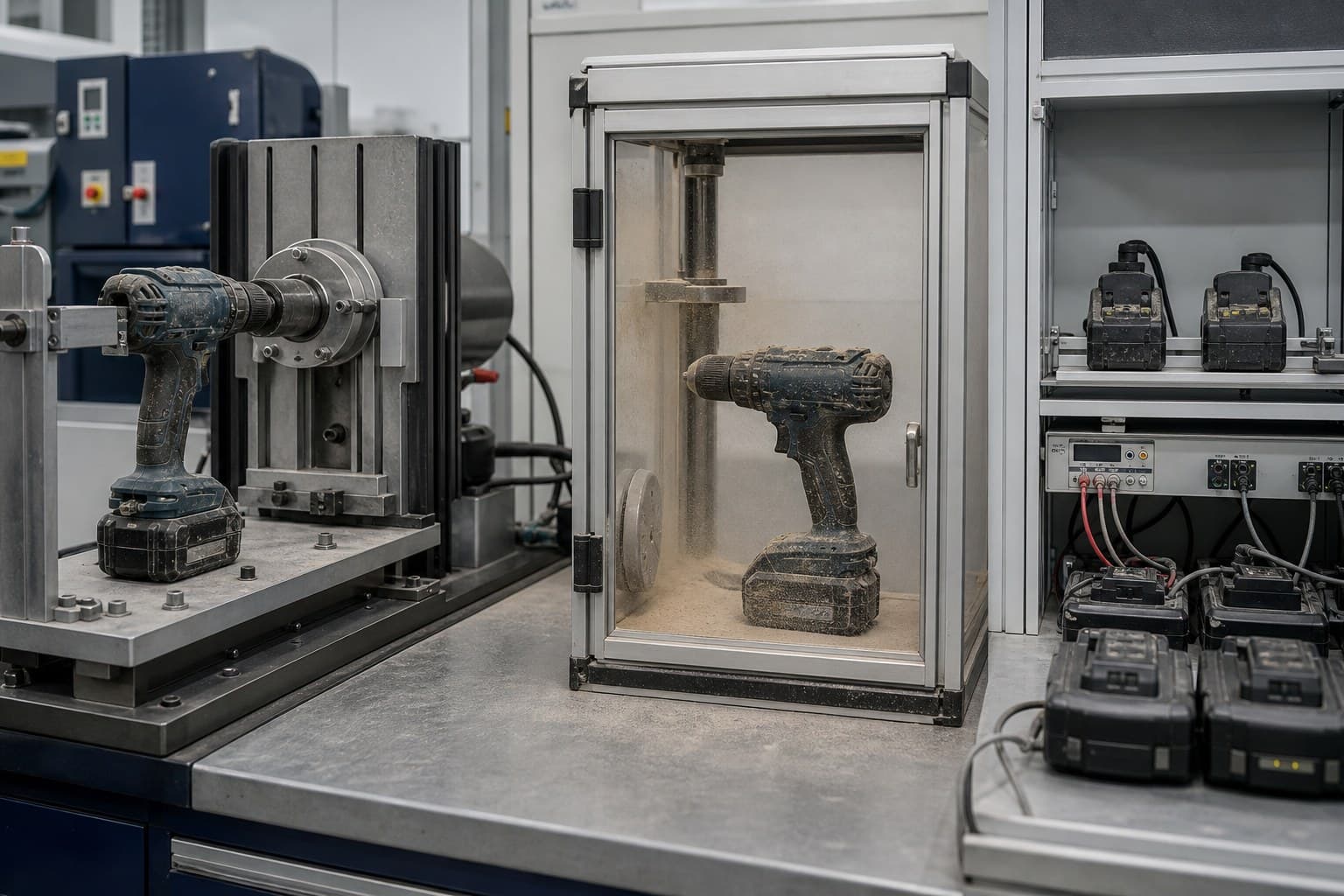
Project example: Explain cordless-tool warranty failures by user profile
- Challenge
- The overall failure rate appears acceptable, but certain markets and applications show much earlier battery and gearbox damage.
- Approach
- RelTest segments use and climate, cleans returned-part data, maps damage patterns to mechanisms and develops representative load and charge profiles for system tests.
- Result
- Design and purchasing obtain a robust basis for component changes, supplier requirements and warranty forecasts without reducing every user to one average.
Deliverables: user and market segments · damage-pattern classification · system test profiles · warranty and action assessment
Battery, charging electronics and housing as a system
Cells, protection circuit, temperature sensor, charger and housing determine safety and lifetime together. A system-level view exposes interactions that isolated component tests can miss.
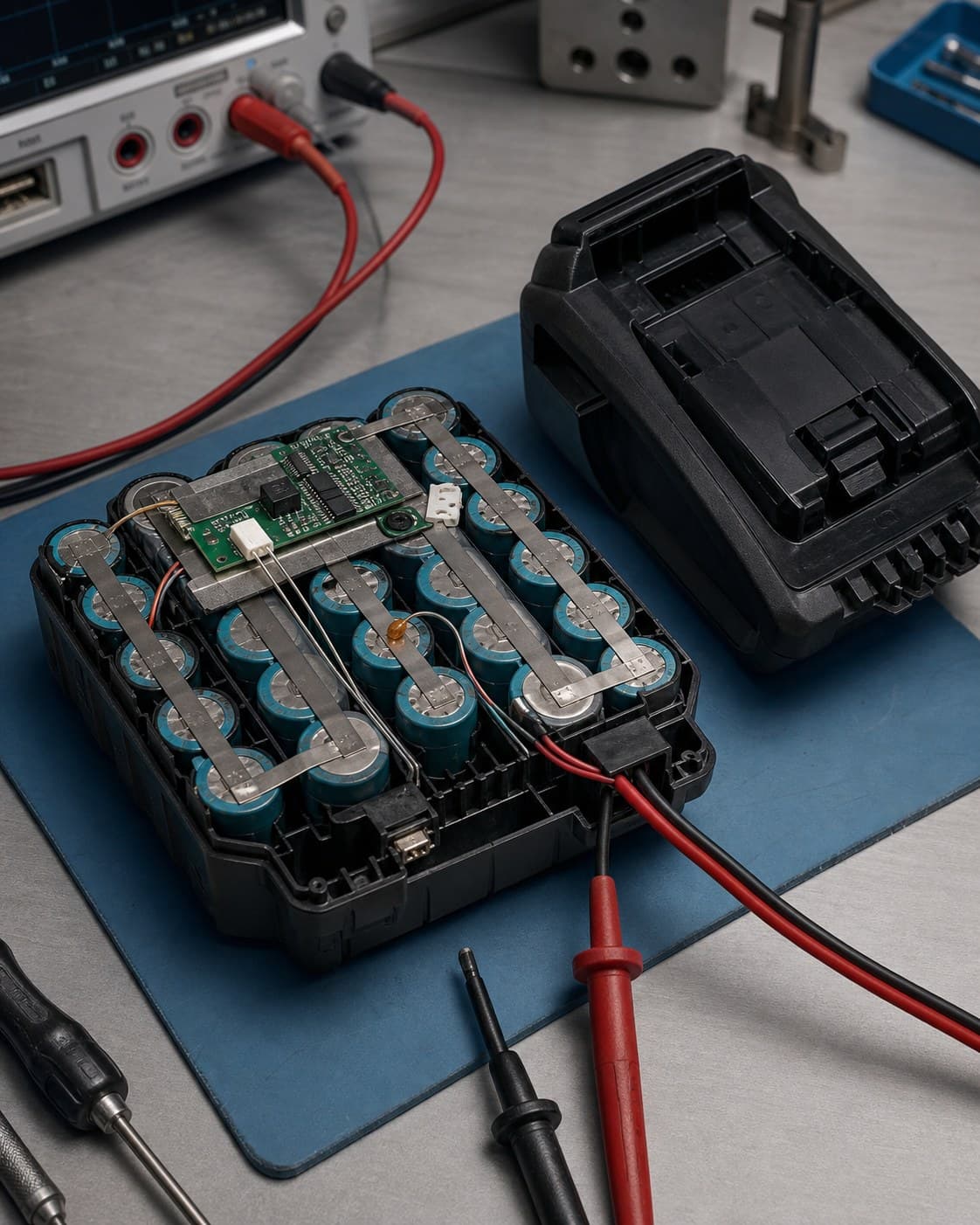
Practical example: The Galaxy Note7 recall made battery safety a system issue
In 2016, the U.S. Consumer Product Safety Commission documented the recall of about one million Galaxy Note7 devices in the United States after lithium-ion batteries could overheat and catch fire. The case shows why packaging, cell, production, charging electronics and use must be assessed together.
For consumer reliability, a passed component programme does not replace system evidence under real charge, temperature, mechanical tolerance and production variation.
Fast, focused assurance for consumer products
We connect engineering depth with commercial development targets. The key is to test the right risks early.
Use and reliability targets
Customer use, quality targets and product lifetime are translated into measurable requirements for development and release.
Focus areas: Use profiles · Target reliability · Robust design
Explore serviceProduct and cost risks
We prioritise failure modes by customer effect, frequency and commercial impact and focus actions on decisive weaknesses.
Focus areas: Risk analysis · Weaknesses · Returns management
Explore serviceAccelerated testing and DoE
Experimental design and life data analysis reduce effort, reveal variation and produce useful decisions early.
Focus areas: DoE · Accelerated tests · Returns data
Explore serviceTechnical knowledge
High volumes require early risk prioritisation and a test strategy that does not dilute rare but consequential failures.
Questions we clarify at project start
Which use must our tests cover?
We segment user and environmental profiles and translate them into relevant loads and boundary cases.
How do we find critical factors with little time?
Screening designs and DoE identify main effects and interactions more efficiently than sequential one-factor tests.
Which returns require immediate attention?
Frequency, customer effect and technical criticality create a traceable priority.
How do we avoid overtesting?
Every test is linked to a specific risk or evidence claim, making redundant testing visible.
Engineering context
Fast development without hidden reliability gaps. Not every consumer failure is safety-critical, but every unnecessary return affects cost and brand. A risk-based test strategy addresses both.
Smart devices · Household and leisure products · Accelerated testing · Warranty and returns data