
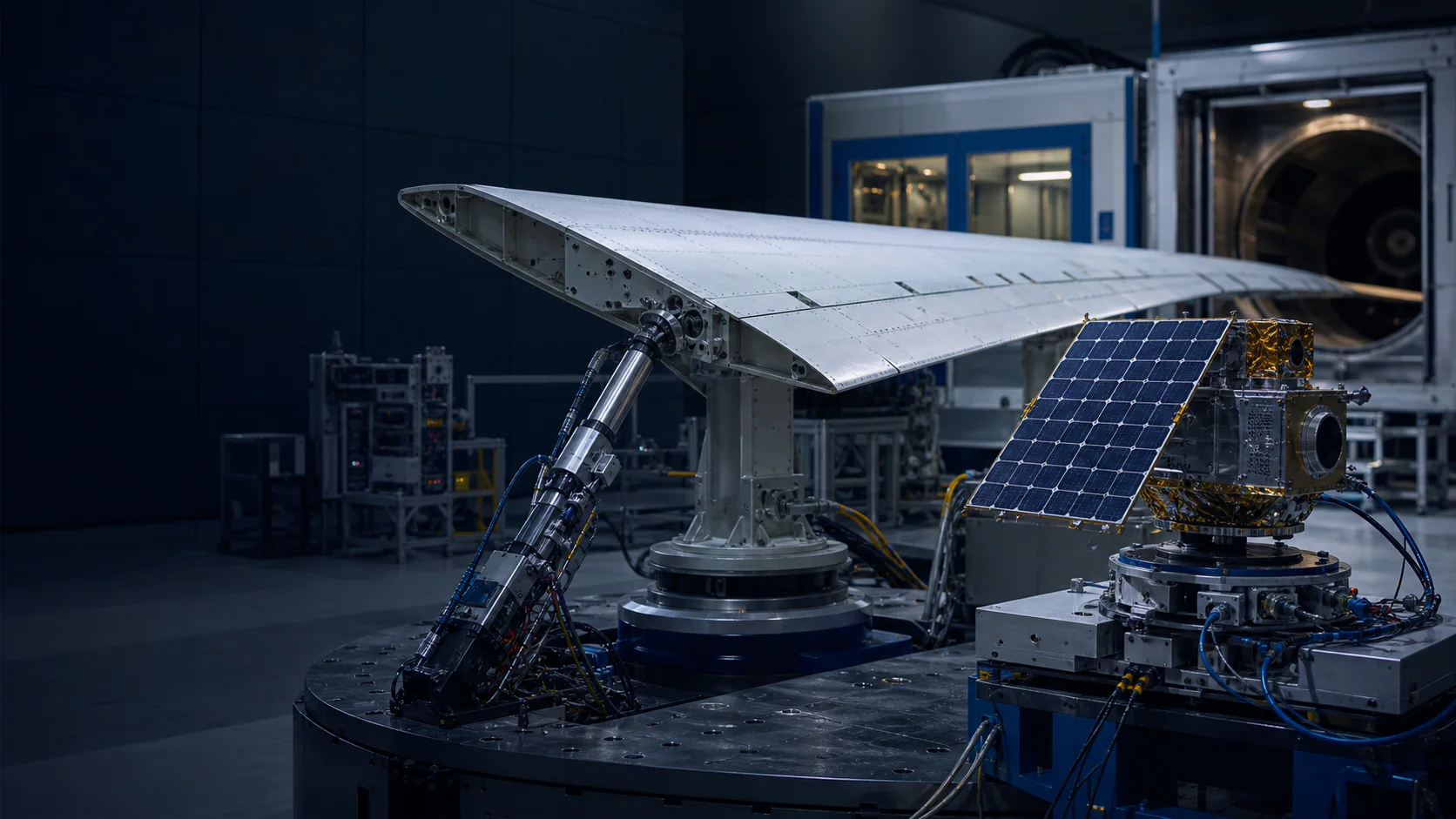
Every aerospace reliability statement must fit the mission
Aerospace reliability engineering operates with small populations, extreme environments, strong system coupling and often no possibility of repair. Avionics, actuators, structures and space mechanisms therefore require an evidence chain spanning analysis, qualification, acceptance testing and controlled assumptions.
RelTest supports aerospace reliability, FMEA and FTA, RAMS and dependability assessments, DO-160-related environmental testing and statistical demonstration planning. Mission profile, common-cause risks and redundancy are treated as one system decision.
When consequences are high, the engineering argument must be complete.
RelTest connects system architecture, failure mechanisms, environmental loads and evidence. This clarifies which risks need design mitigation, testing, analysis or redundancy.
- MissionDefine function, mission profile and acceptable consequences.
- ArchitectureAnalyse dependencies, redundancy and critical paths.
- AssuranceCombine analysis, test and documentation based on risk.
- DecisionAssess residual risk and evidence limitations transparently.
Reliability along a mission chain
The question is not only whether a component works, but when, for how long and in which system state its function is required.
Electromechanical flight-control actuator
Load collective, temperature, lubrication, sensing and control determine available motion.
Risk fieldGear and bearing fatigue, jamming, sensor drift, latent faults and common power loss.
EvidenceMission profile, FTA, lifetime and environmental testing, and monitoring of safety-relevant degradation features.
Avionics LRU
Electronics, software, connectors and cooling operate under vibration, pressure and temperature changes.
Risk fieldContact and solder faults, overheating, transient resets and insufficient fault detection.
EvidenceDO-160-related environments, functional monitoring, fault injection and configuration evidence.
Satellite mechanism
Launch loads, vacuum, radiation and long dormant periods meet a very small test population.
Risk fieldCold welding, lubricant loss, material degradation, single-point failure and deployment failure.
EvidenceWorst-case analysis, qualification model, thermal-vacuum and vibration testing, and probabilistic uncertainty.
Mission chain from launch to functional phase
Vibration, thermal vacuum, standby and functional operation stress a space system in different ways. The mission chain assigns dominant loads, failure mechanisms and evidence to each phase and makes qualification gaps visible.
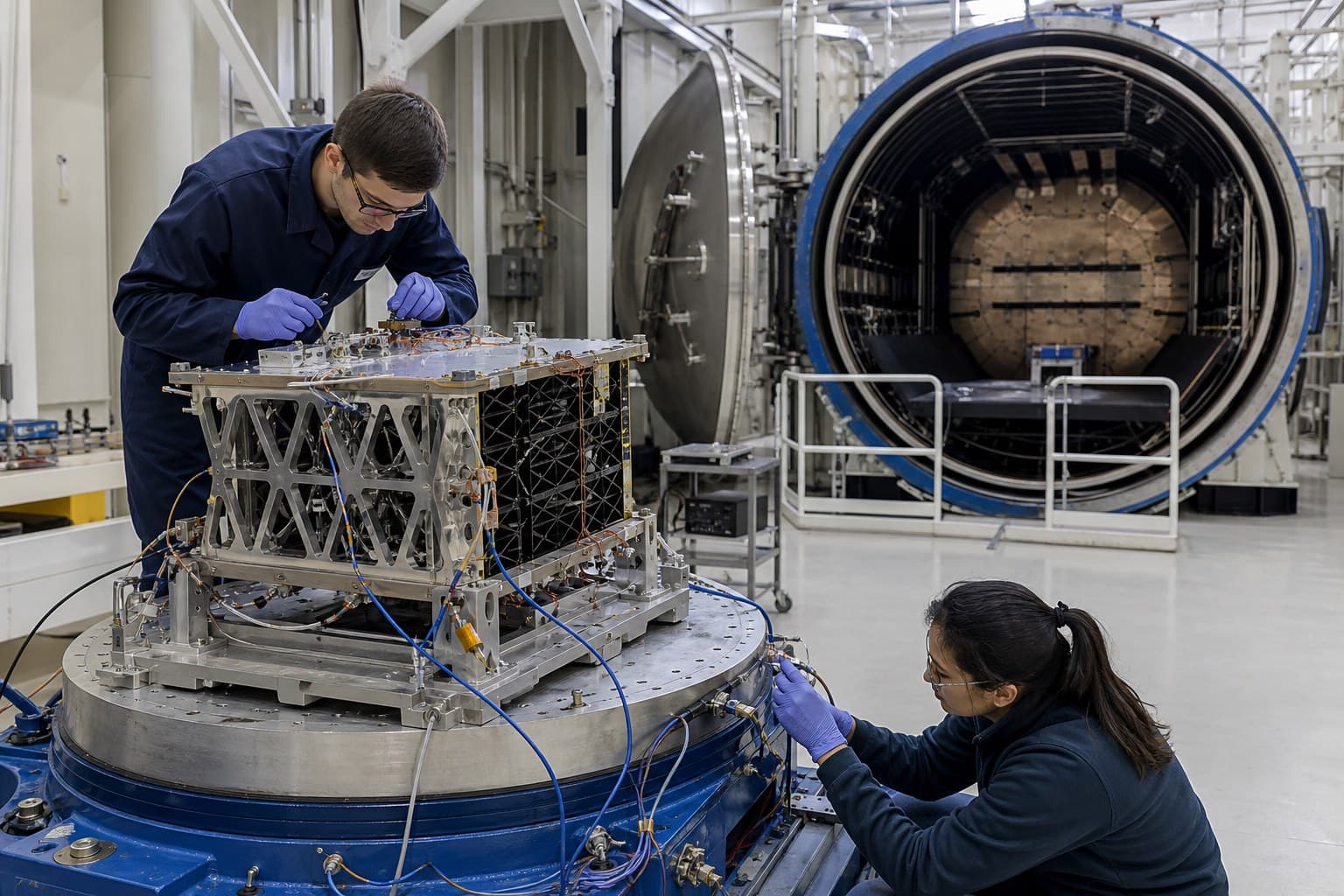
Project example: Transfer actuator qualification evidence to a changed mission profile
- Challenge
- A proven actuator is planned for a new platform with different load peaks, longer standby and a changed thermal environment.
- Approach
- RelTest compares old and new mission profiles, maps loads to failure mechanisms, assesses evidence coverage and redundancy assumptions, and defines targeted delta qualification.
- Result
- The decision separates reusable evidence from genuine gaps. Unnecessary repeat testing is reduced without hiding new mission risk.
Deliverables: mission-profile delta · mechanism and coverage matrix · delta-qualification plan · justified release limits
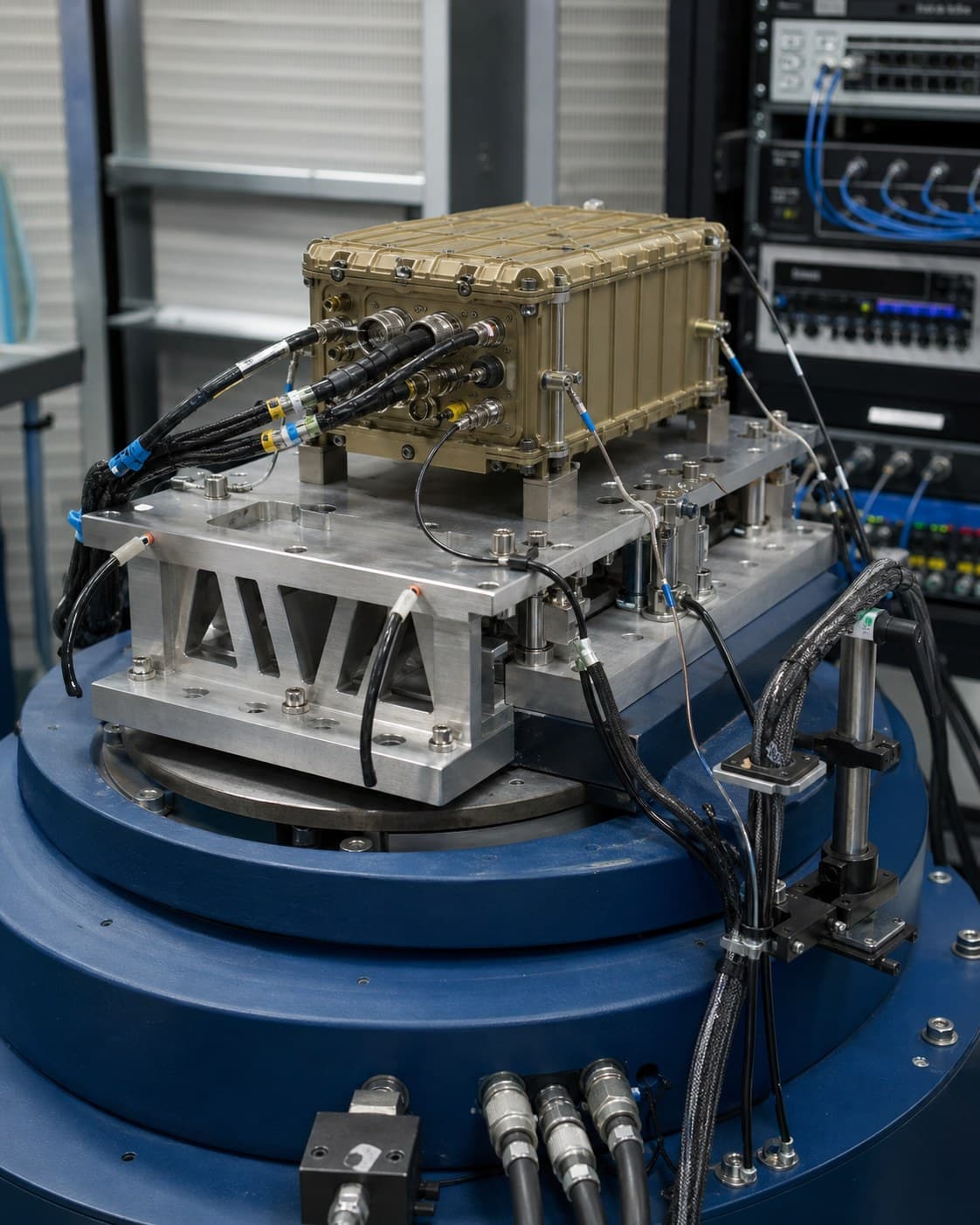
Avionics LRU in a representative environmental test
Vibration, temperature and function are not assessed in isolation. Continuous functional monitoring shows whether the avionics unit meets its requirements throughout the environmental profile and exposes intermittent faults as they occur.
Practical example: Ariane 501 shows the limit of reuse without representative system qualification
The ESA inquiry into the 1996 Ariane 5 failure traced the loss to specification and design errors in the inertial-reference-system software. Reviews and testing had not represented the reference system and complete flight-control system adequately.
The engineering lesson remains current: proven components are reliable only inside demonstrated operating boundaries. New missions require systematic delta analysis and representative end-to-end testing.
Integrating reliability, risk and assurance
We support system and component projects with a methodical, documentation-focused approach scaled to criticality and project phase.
Reliability and system assessment
Reliability targets, block diagrams and lifetime models quantify system contributions, dependencies and critical components.
Focus areas: Reliability allocation · System reliability · Lifetime
Explore serviceRisk, FMEA and fault trees
We structure top events, causes, common-cause risks and actions and review consistency between analysis, architecture and evidence.
Focus areas: FMEA and FTA · Common cause · Assurance reviews
Explore serviceEnvironmental testing and evidence data
Test profiles, samples and data evaluation are aligned with mission, mechanism and the required claim.
Focus areas: Environmental tests · Demonstration planning · Life data
Explore serviceTechnical knowledge
Risk, assurance and prognosis must refer to the same mission state and system architecture.
Questions we clarify at project start
Which component dominates mission risk?
System models and fault trees reveal critical paths and make redundancy and dependency assumptions explicit.
Are analysis and test strategy consistent?
We verify whether prioritised mechanisms are addressed by design, inspection or relevant tests.
How can small samples support robust evidence?
Physical models, prior knowledge, conservative limits and statistical evidence are combined transparently.
Will decisions remain traceable?
Assumptions, sources, model limits and review results are documented and versioned.
Engineering context
Dependability as an integrated engineering task. Reliability, availability and maintainability are not isolated. Their interactions must match the mission, system architecture and assurance strategy.
ECSS dependability context · RAMS · FMEA and fault-tree analysis · Environmental and lifetime evidence