

Medical devices need a closed chain of risk, evidence and post-market data
Medical-device reliability covers more than component life. For infusion pumps, diagnostic systems, surgical instruments and active medical devices, technical failures, software, the use environment and potential patient harm must be assessed together.
RelTest supports medical device reliability, ISO 14971-oriented risk management, design verification and validation, reliability demonstration and post-market data analysis. The engineering argument links hazard, failure cause, risk-control measure and evidence across the full product lifecycle.
Evidence is persuasive when risk, requirement and test are fully linked.
RelTest supports the engineering side of risk management: understanding failure mechanisms, defining reliability targets, justifying tests and documenting results so decisions remain traceable.
- UseDefine use, environments and safety-relevant functions.
- RiskConnect hazards, technical failures and controls.
- EvidencePlan verification, lifetime and samples based on risk.
- DocumentationRecord assumptions, results and residual risk transparently.
Assess products by clinical function and risk path
The same failure probability can have a completely different meaning depending on the clinical function.
Infusion pump
Mechanics, sensing, software, consumables and operation jointly determine delivered dose.
Risk fieldOver- or under-infusion, blocked flow, battery failure, alarm and user-interface faults.
EvidenceSafety case, flow accuracy across states, software tests, use environment and post-market signals.
Diagnostic analyser
Sample handling, reagent, optics, thermal control and algorithm influence the result.
Risk fieldDrift, contamination, misclassification, undetected calibration deviation and loss of availability.
EvidenceMeasurement-system analysis, robustness DoE, boundary testing and traceable fault detection.
Electromechanical surgical instrument
Force, motion, sterilisation, reprocessing and user interaction act on safe function.
Risk fieldBlocking, mechanical fracture, seal loss, sensing faults and degraded performance after reprocessing cycles.
EvidenceLifetime cycles, worst-case configuration, usability and documented risk-control evidence.
Safety case for an infusion pump
Dosing function, sensors, software alarms and mechanical verification form one safety argument. A traceable evidence chain shows which control addresses each significant hazard and how its effectiveness is demonstrated.
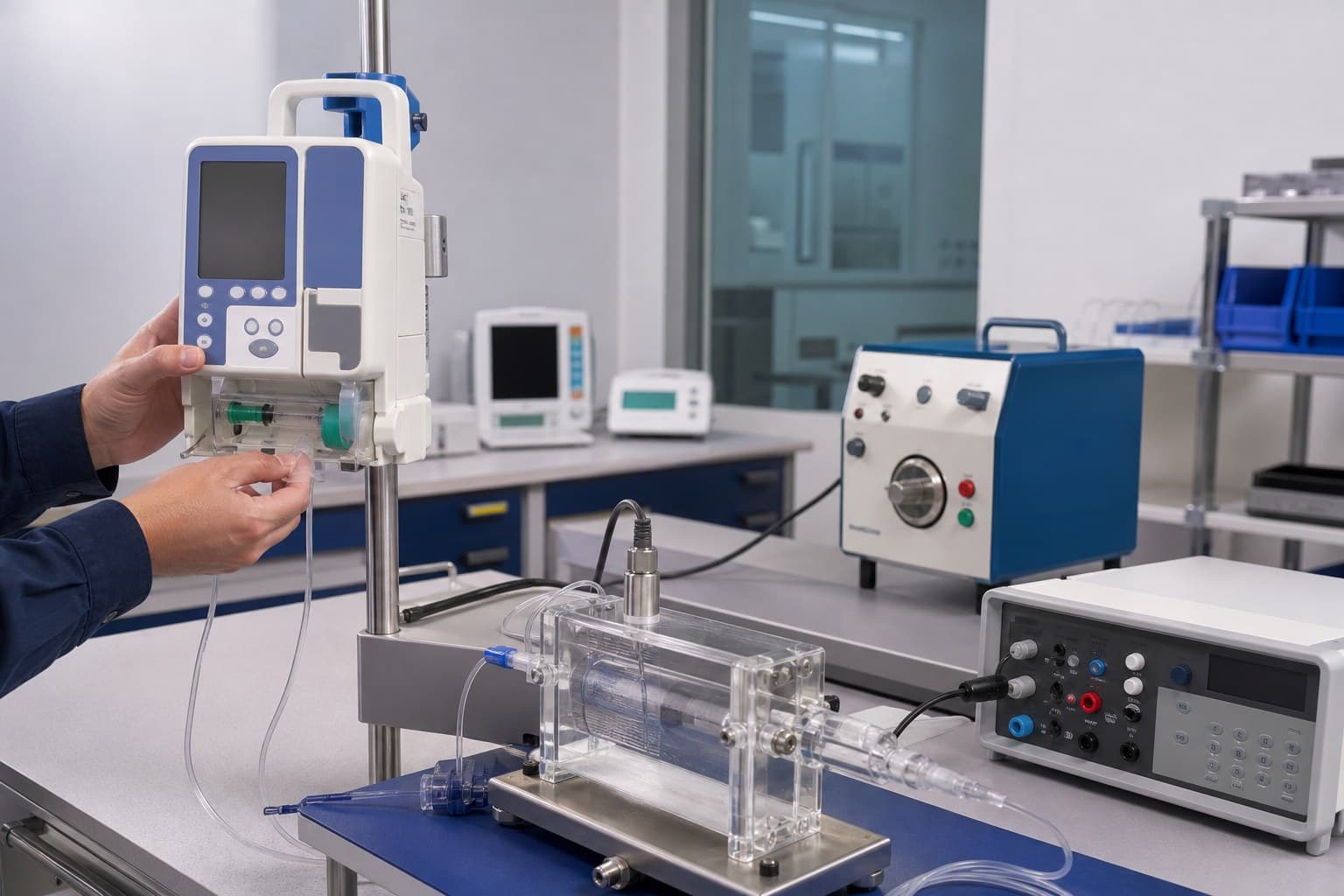
Project example: Close the evidence chain for infusion-pump risk controls
- Challenge
- FMEA, software tests and mechanical verification exist but cannot be traced clearly to specific hazardous situations and clinical operating states.
- Approach
- RelTest structures hazard, sequence of events, technical cause and control, assigns existing tests and defines missing boundary and environmental evidence.
- Result
- The evidence case shows what supports each significant control, which assumptions apply and how production and post-market data feed back into the argument.
Deliverables: risk-evidence matrix · test and traceability gaps · supplementary verification plan · engineering safety-case contribution
Test after cleaning and sterilisation
Repeated reprocessing can gradually change seals, surfaces and actuation forces. Measurements and visual findings are therefore tracked across cycles and assessed against a predefined acceptance criterion.

Practical example: The FDA infusion-pump initiative strengthened the total-product-lifecycle perspective
In 2010, the FDA responded to persistent infusion-pump safety problems including software, user-interface, mechanical and electrical failures. The initiative called for more detailed engineering information, use-specific design validation and stronger links between development and post-market observation.
The reliability lesson is that tests must represent the use environment and risk controls. Field signals are part of the safety argument, not a downstream quality report.
Technical assurance for medical devices
We complement regulatory processes with robust reliability methods and connect the risk file, development and testing.
Reliability requirements and lifetime
We define quantitative targets, assess use and ageing and plan evidence for components, devices and technical functions.
Focus areas: Reliability targets · Lifetime assessment · Verification
Explore serviceTechnical risk management
Failure mechanisms, effects and risk-control measures are linked methodically and reviewed for consistency.
Focus areas: ISO 14971 context · FMEA and FTA · Risk control
Explore serviceTesting and statistical evidence
We plan sample sizes and duration, evaluate failures and censored data, and document the strength of evidence.
Focus areas: Lifetime testing · Demonstration planning · Data analysis
Explore serviceTechnical knowledge
Medical reliability becomes robust when planning, risk management and assurance reference the same requirements.
Questions we clarify at project start
Is the reliability requirement measurable?
We translate expectations into metric, target, period, population and required confidence.
Does verification cover identified risks?
A traceability review reveals gaps between technical cause, risk control and planned evidence.
How can we work with limited samples?
Risk-based planning, prior knowledge and suitable models balance evidence and effort transparently.
What can post-market data tell us?
Field and service data are structured to identify trends, populations and potential new failure patterns.
Engineering context
Engineering depth in a regulated environment. RelTest does not replace regulatory consulting. We provide the engineering method, analysis and evidence logic that gives technical substance to risk and development documentation.
ISO 14971 · EU MDR context · Verification and validation · Post-market data