
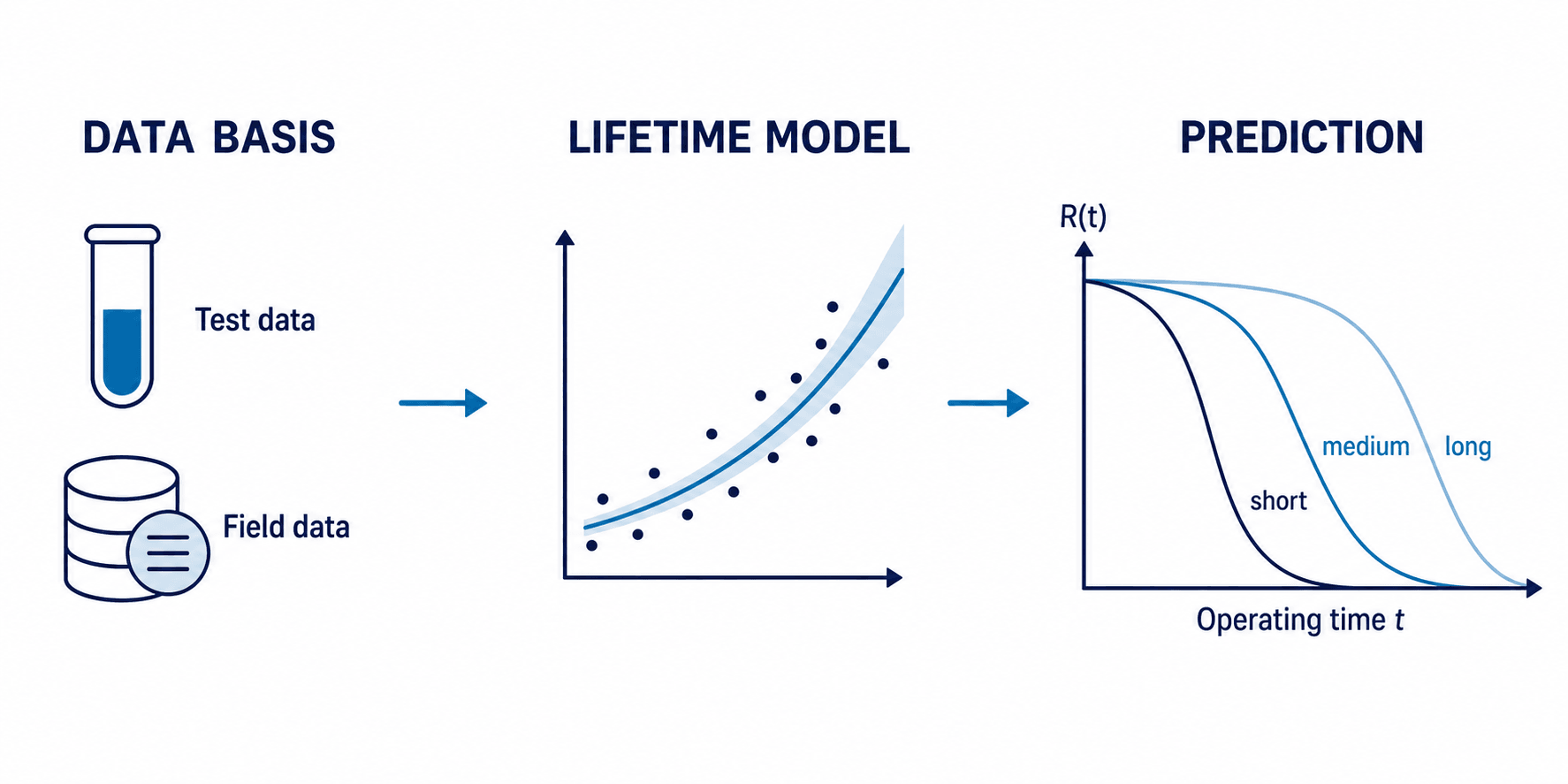
Understand how the data were created
Test, operating and field data are not automatically comparable. Load, use, observation time, censoring and failure definitions shape the result.
Incomplete observations can still provide information when their context is documented.
Select models technically
Weibull, exponential and other distributions describe different failure behaviours. Selection must fit both data and mechanism.
Stress–life models are particularly sensitive because extrapolation can become invalid when the failure mechanism changes.
A defensible prognosis follows three steps: understand the data in context, select a technically appropriate model and present the extrapolation together with its uncertainty.
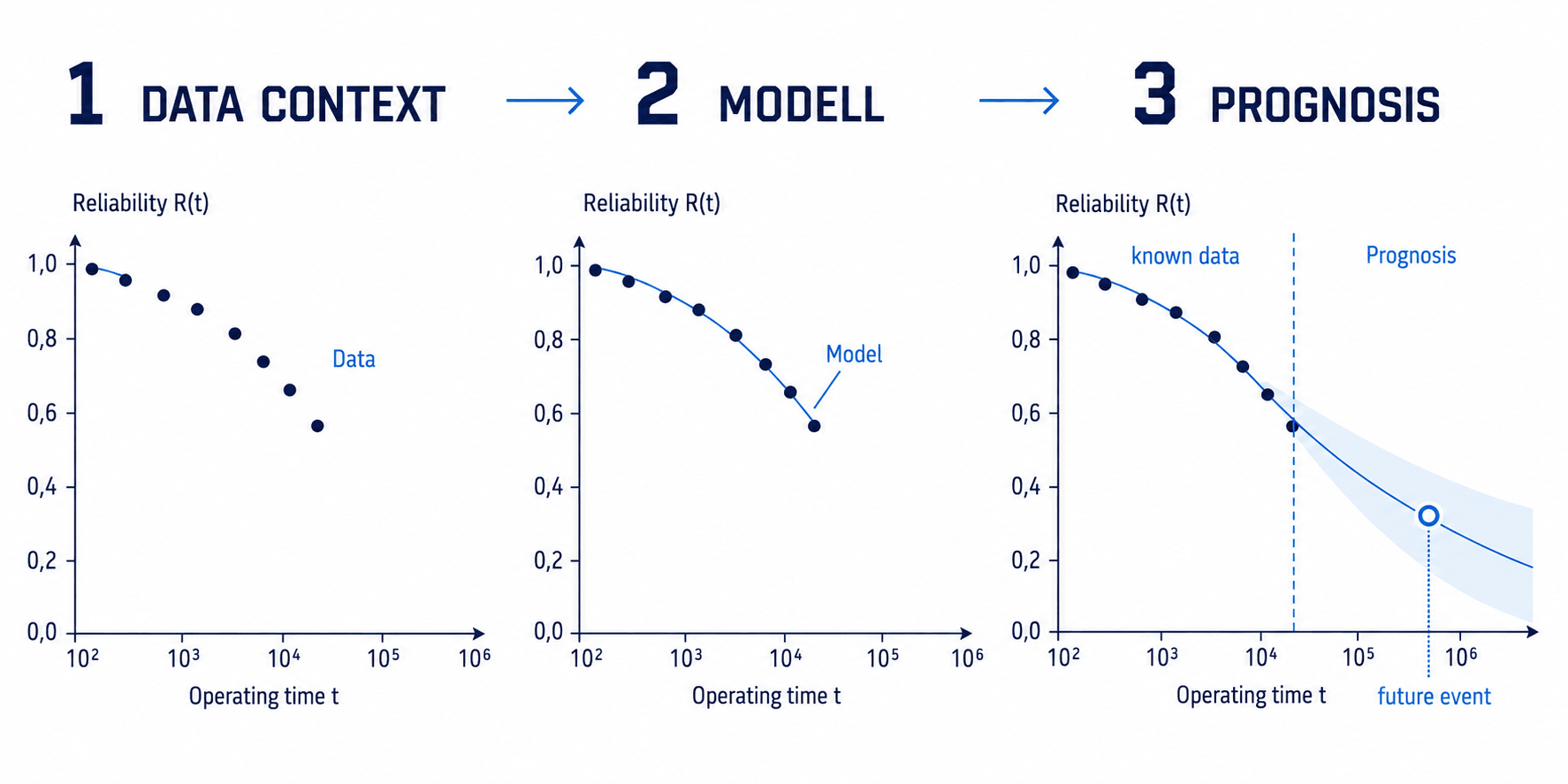
Uncertainty is part of the result
A prediction is a statement with statistical and technical uncertainty, not a certainty.
Confidence bounds, sensitivities and documented assumptions are therefore as important as the point estimate.