
All news

Webinar

Webinar: Efficient Life Test Planning

How sample size, test duration, confidence and probability of test success can be combined into an economical demonstration strategy.

A life test is not efficient merely because it uses few specimens or a short duration. What matters is whether the chosen effort supports a clearly defined reliability statement with sufficient certainty.

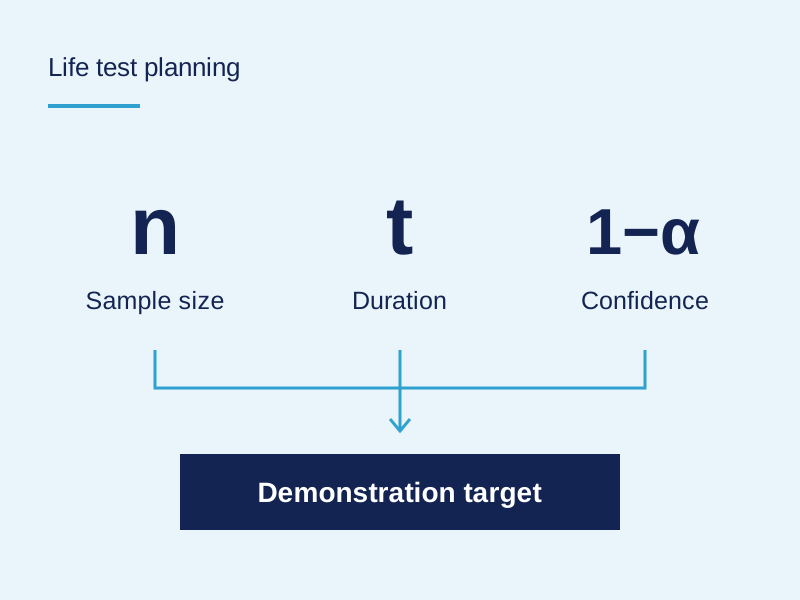
Schematic life test planning: sample size, duration and confidence are aligned with the demonstration target
The webinar considers test effort and statistical evidence together, from target definition to the probability of a successful demonstration.

Begin with the decision

Before defining sample size and duration, the required decision must be clear. Reliability target, mission time or cycles, permissible failure fraction and confidence level have to be stated unambiguously. Without this framework, test effort cannot be evaluated or optimised.

Confidence alone does not fully plan the test

A demonstration may be statistically valid and still have a low chance of passing when the true product reliability lies only slightly above the target. The probability of test success therefore complements confidence: it describes the planning risk of obtaining the required evidence with the selected design.

Compare test strategies on a common basis

Failure-free tests, time-censored tests and plans with permissible failures distribute effort differently. A useful comparison considers specimen count, duration per specimen, total accumulated time, assumptions about the lifetime distribution and the consequence of a failed demonstration.

Allocate effort deliberately

An efficient plan does not minimise one variable in isolation. It balances available specimens, test-bench capacity, calendar time and statistical evidence, while leaving a transparent path for evaluation and follow-up decisions.

Plan tests more efficiently

RelTest develops test strategies that use available time and specimens economically while supporting a defensible engineering decision.