
All news

Webinar

Webinar: Accelerated Life Testing

A technical distinction between HALT and ALT, including acceleration models, failure mechanisms and limits of interpretation.

The similar names Highly Accelerated Life Test (HALT) and Accelerated Life Test (ALT) can create misleading expectations. The webinar establishes a common technical basis and explains which question each test can actually answer.

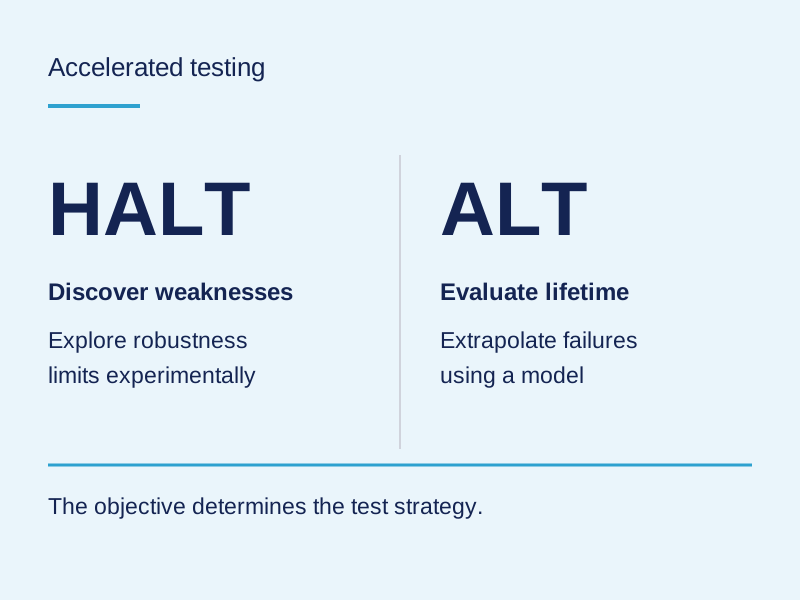
HALT explores weaknesses and robustness limits; ALT evaluates lifetime using an acceleration model
The webinar places HALT and ALT within qualitative and quantitative reliability testing and clarifies their different objectives.

HALT and ALT answer different questions

HALT is primarily used to reveal robustness limits and weak points early. ALT, in contrast, is intended to produce time-dependent failures more quickly under increased but physically justified stress and to enable a quantitative transfer to service conditions. A HALT result is therefore not automatically a statistical lifetime demonstration.

The failure mechanism is the constraint

Acceleration is meaningful only while the relevant failure mechanism remains unchanged. Excessive temperature, vibration or load may activate artefacts that would not occur in service. Test levels must therefore be derived from product physics, usage and the intended statement rather than from the shortest possible duration.

Acceleration models need transparent assumptions

Models such as Arrhenius, inverse power law or combined approaches translate elevated stress to service conditions. Their parameters, applicable range and uncertainty need to be documented. A precise calculation cannot compensate for an unsuitable model or an unrepresentative test condition.

From test result to development decision

A sound plan connects objective, specimen, load profile, failure criterion and evaluation before the test begins. The result can then support design changes, further testing or release decisions without claiming more than the available evidence provides.

Plan accelerated tests on a sound basis

RelTest connects test objectives, product physics, stress levels and statistical evaluation into a defensible testing strategy.